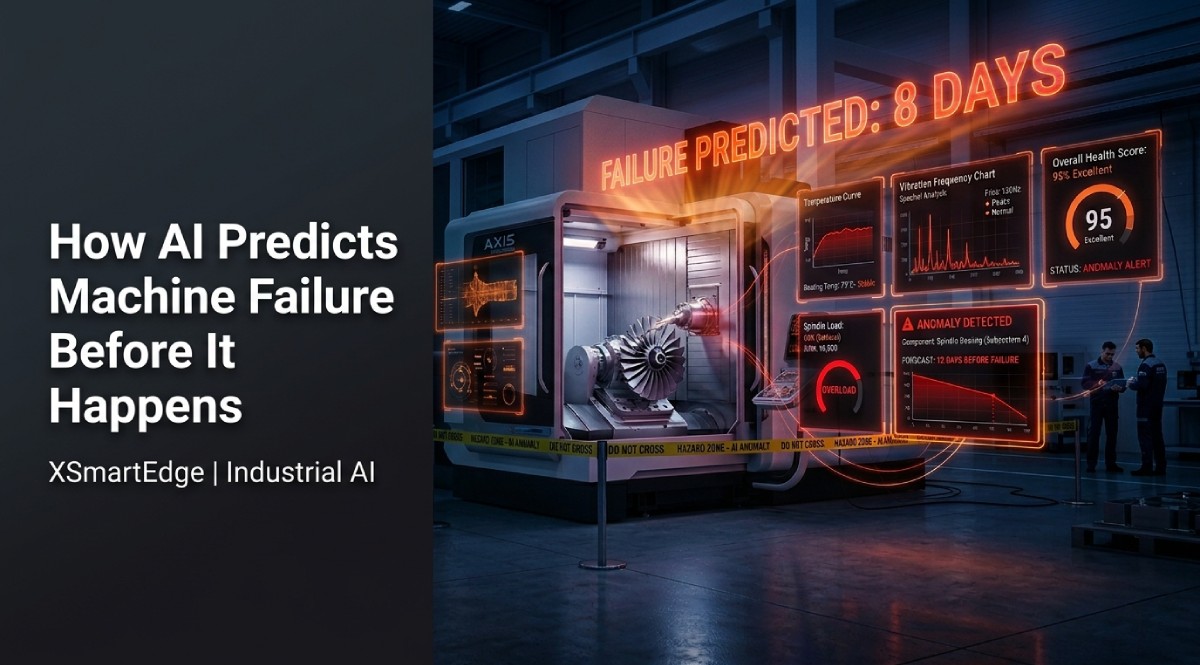
The factories that master this will never be caught off guard again.
The ones that don’t — will lag behind.
The 2 AM Call Nobody Wants
It’s 2 AM on a Tuesday.
Your phone rings.
Production supervisor. Line 4 is down. Complete shutdown. Machine failure — bearing seized.
By morning — 8 hours of lost production. Maintenance Team summoned in emergency. Spare parts airlifted from the supplier. Three customer deliveries delayed.
Final damage: Few good Lakhs or tens of lakhs. Gone. In one night.
The Irony?
When your engineer pulled the sensor logs the next morning — the warning signs had been there for 11 days already.
Temperature gradually climbing. Vibration subtly increasing. Energy consumption creeping up.
The machine was screaming for help.
For 11 days.
Nobody heard it.
This is not a maintenance problem. This is not a technology problem.
This is a data problem. And AI just solved it permanently.
Why Traditional Maintenance is not optimal
Before we talk about how AI predicts failure — we need to be honest about why traditional approaches are not optimal.
Reactive Maintenance — Fix it when it breaks.
This is still the reality in 60% of Indian manufacturing facilities. You run the machine until it fails. Then you fix it. Then you run it until it fails again.
The cost? Not just the repair. The unplanned downtime, the production loss, the rushed logistics, the emergency labour premiums, the customer penalties.
One bearing costs ₹2,000 to replace when planned.
The same bearing costs few good lakhs when it fails at peak production.
Scheduled Maintenance — Fix it on a calendar.
Better than reactive — but flawed. You are maintaining machines based on time, not on condition.
Your calendar says service Machine 7 every 90 days. But Machine 7 has been running at 140% capacity for 3 weeks. It needs service in 45 days. Not 90.
Meanwhile, Machine 3 — running light loads — gets serviced at 90 days too. Perfectly healthy components get replaced. Money wasted.
Scheduled maintenance is a 1970s solution being applied to a 2026 challenge.
Predictive Maintenance powered by AI
The Science Behind How AI Sees What Humans Cannot
Your machine speaks in data.
Every single second — it generates signals across dozens of parameters.
Temperature at 14 different points. Vibration frequency across 3 axes. Current draw. Pressure levels. Rotation speed. Oil viscosity changes. Acoustic emissions.
A single machine on a single shift generates millions of data points per day.
No human engineer can monitor millions of data points in real time. Across dozens of machines. Across multiple shifts. Across every day of the year.
But AI can. This is mathematics — applied to the right problem.
The 4-Layered AI System That Predicts Failure
Layer 1 — Continuous Data Collection
Sensors across your equipment stream data 24 hours a day to the AI platform. Temperature sensors. Vibration accelerometers. Current transducers. Pressure transmitters.
The AI receives every reading. Every second. Without gaps. Without fatigue. Without missing a single anomalous spike at 3 AM.
Layer 2 — Baseline Learning
When you first deploy AI predictive maintenance — the system spends time learning what “normal” looks like for every machine.
Normal vibration for Machine 7 during morning shift startup. Normal temperature curve during peak production hours. Normal energy consumption for a standard production cycle.
This is the AI building a fingerprint of your equipment’s healthy state.
It takes into account — production load, ambient temperature, material type, shift patterns. It does not just learn one “normal.” It learns hundreds of contextual normals.
Layer 3 — Anomaly Detection
Once the AI knows what normal looks like — it watches for deviation.
Not just threshold breaches — any reading crossing a static alarm limit. That is what your SCADA already does.
AI detects subtle pattern shifts that happen weeks before a threshold is ever breached.
A bearing developing early-stage wear does not immediately spike temperature. It creates a micro-pattern change in vibration — a frequency signature that is invisible to the human eye and imperceptible to a standard alarm system.
AI catches it. On Day 2. Not Day 11.
Layer 4 — Failure Prediction and Recommended Action
This is where AI separates itself from every other monitoring technology.
It does not just say — “Anomaly detected.” It says:
“Machine M-07, Line 3 — Bearing wear detected. Estimated time to failure: 8 to 14 days at current operating load. Recommended action: Schedule bearing replacement during next planned production window. Estimated repair time: 3 hours. “
From anomaly to action. Automatically. Before any damage occurs.
The Numbers That Make the Business Case Undeniable
Manufacturing companies that have deployed AI predictive maintenance consistently report the same results across industries.
Unplanned downtime reductions of 40 to 70 percent. Not because machines stopped failing — but because failures stopped being surprises.
Maintenance cost reductions of 25 to 30 percent. Because you stop replacing healthy components on a calendar and start replacing only what actually needs replacing.
Spare parts inventory reductions of 20 to 25 percent. Because AI tells you exactly what parts you need and when — so you stop overstocking everything just in case.
Overall Equipment Effectiveness improvements of 10 to 20 percentage points. Because your machines spend more time producing and less time being repaired.
For a mid-size Indian manufacturer running 3 production shifts — this typically translates to few good crore in annual savings.
The AI platform that delivers this costs a fraction of a single major unplanned breakdown.
The ROI argument is not complicated. One prevented catastrophic failure often pays for 2 to 3 years of the platform.
What AI Predictive Maintenance Actually Looks Like — Day to Day
Monday 6:30 AM. Plant Manager opens Conversational AI platform.
Types: “Any machines showing early warning signs this week?”
Response: “Machine C-03, Compressor Hall — vibration anomaly on drive-end bearing detected since Day 3. Confidence: 87%. Estimated remaining useful life at current load: 12 to 18 days. Recommend schedule during upcoming Sunday maintenance window.”
Plant Manager forwards to maintenance team. Sunday window booked. Bearing ordered from supplier — 4 day lead time, arrives Thursday.
Sunday — bearing replaced. 2.5 hours. Normal production resumes Monday.
Total cost: bearing ₹3,200 + 2.5 hours labour.
What it would have cost if ignored: complete production line down, emergency maintenance, few good lakhs in losses.
This is predictive maintenance in practice. Not a concept. A daily operational reality.
The question is — how many more 2 AM phone calls are you willing to receive before you implement it?